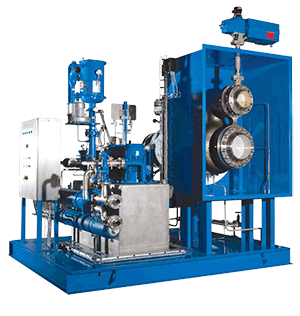
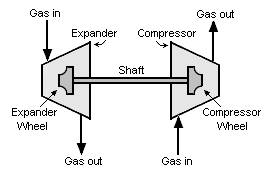
A cold production unit is required to maintain the proper operating temperatures in the process and offset the heat leak into the cold box. Normally for a low–pressure gas plant, an expansion turbine is provided as a cold production unit. In the more recently designed plants, the turbine operates on a small, clean airflow that has been boosted in pressure by its compressor brake (expander–booster).
An air separation unit requires a refrigeration cycle that operates the Joule–Thomson effect to achieve low distillation temperatures. The cold equipment must be kept in an insulated enclosure called a “cold box”. The cooling of the gases requires a lot of energy to make this refrigeration cycle work and is delivered by an air compressor. Modern ASUs use expansion turbines for cooling; the expander’s output helps drive the air compressor for improved efficiency.
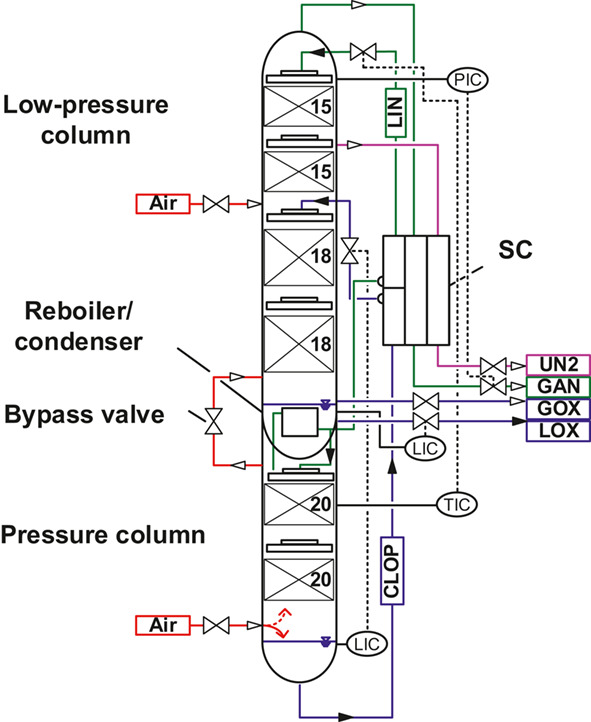
A double column is used for the cryogenic distillation of air. In air separation plants is, a combination of two columns used. This process was pioneered by Carl von Linde in the early 20th century and is still used today to produce high-purity gases. He developed it in 1895; the process remained purely academic before it was used in industrial applications for the first time (1902).
The lower part is a “half” single column with a condenser at the top, and an air feed at the bottom, whereas the upper part, is a single column without a condenser but with a reboiler.
The condenser in the lower column acts as the reboiler for the upper column; those two are thermodynamically attached. Air, normally at a temperature just above the dew point, is fed to the bottom of the lower column.
Vapor raises the column to the condenser and forms reflux. “Rich liquid” contains approx. 35-40 % oxygen is taken out as the bottom product, and nitrogen is the top product. The bottom product, the rich liquid, is then fed to the center part of the upper column for further separation. In this upper column, there is no condenser, but reflux is taken from the pure top product of the lower column.
A reboiler at the bottom of the upper column is heated from the condensing of nitrogen in the lower column. The upper column can have pure oxygen at the bottom, as oxygen has a higher boiling point than nitrogen.
An argon-rich stream is withdrawn from the middle of the LP column and refined to a pure product in other 03 distillation columns, which are called crude Argon column, semi-pure Argon column and Nitrogen removal column



 English
 Urdu
Urdu